Tone Shift — How One Number Defines Your Entire UI Color System
Design tokens are how teams formalize color decisions. text-primary: blue-900. border-subtle: blue-200. surface-hover: blue-100. Someone decided those values. Someone else disagreed. You shipped it and moved on.
Six months later, the palette is updated. Every token needs re-evaluation. The decisions that were made by eye need to be remade by eye.
There is a different approach.
What You Already Have
After measuring a palette, you have two numbers:
- N — the number of shades (e.g., 12)
- K — the contrast span — minimum steps for WCAG AA contrast (e.g., 5)
From K, every semantic role follows from arithmetic:
| Role | Distance from surface | Why |
|---|---|---|
| Text | ±K | Minimum distance for readable body text |
| Border | ±⌊K/3⌋ | Visible but not dominant — decorative contrast |
| Hover | ±1 | Perceptible change, one step away |
| Selected | ±⌊2K/3⌋ | Between border and text — clearly active |
For K=6:
| Role | Steps |
|---|---|
| Text | ±6 |
| Border | ±2 |
| Hover | ±1 |
| Selected | ±4 |
No decisions. No opinions. The relationships are determined by the palette's own contrast structure.
The Tone Formula
A complete surface-role system follows this formula:
T = C_surface + S_zone × I_deltaC_surface— the shade index of the background surface (e.g., shade 2 for a light background)S_zone— direction: +1 for light surfaces (go darker), −1 for dark surfaces (go lighter)I_delta— K, K/3, 1, or 2K/3 depending on the role
For a light surface at shade index 2, K=6:
| Role | Index | Shade |
|---|---|---|
| Surface | 2 | blue-2 |
| Text | 2 + 6 = 8 | blue-8 |
| Border | 2 + 2 = 4 | blue-4 |
| Hover | 2 + 1 = 3 | blue-3 |
| Selected | 2 + 4 = 6 | blue-6 |
For a dark surface at shade index 10, K=6:
| Role | Index | Shade |
|---|---|---|
| Surface | 10 | blue-10 |
| Text | 10 − 6 = 4 | blue-4 |
| Border | 10 − 2 = 8 | blue-8 |
| Hover | 10 − 1 = 9 | blue-9 |
| Selected | 10 − 4 = 6 | blue-6 |
Every surface in the palette — light or dark — gets a full set of roles. No manual assignments. The math determines what works.
What This Replaces
Most design systems define tokens by hand:
- Text on
blue-50background →blue-900 - Text on
blue-900background →blue-50 - Border on
blue-50→blue-200 - Border on
blue-900→blue-700
These are all approximations of K-derived roles — arrived at by eye and encoded as one-off decisions. When the palette changes, they all need updating.
With tone shift, the token system is derived. Change the palette, K is recomputed, all roles update automatically. Dark mode is not a separate system — it's the same formula with S_zone = −1.
The Tone Reference Grid
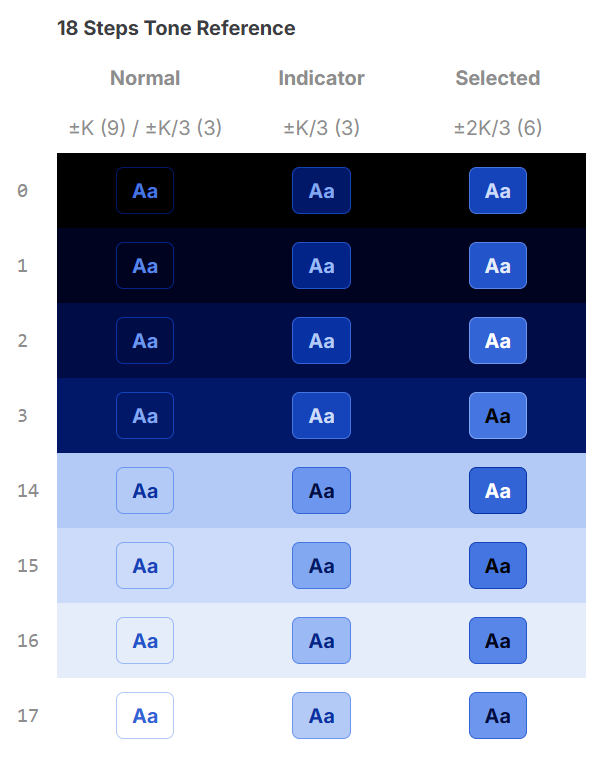
The Tone Reference grid in Chromametry shows this complete matrix:
- Rows: every surface (light region top, dark region bottom)
- Columns: surface, text, border, hover, selected
- Each cell: the derived shade for that role on that surface
Every cell is computed from K. The grid is a visualization of the entire derived token system — for every surface simultaneously.
→ Open the Generator and see the Tone Reference for your palette